BizStack Overview
BizStack is a technology stack created and operated by MODE for collecting, storing, and surfacing “field data”. While it is an end-to-end solution that covers the entire data journey from sensors to users, it is also a platform that offers many opportunities for custom development and integration with other systems.
Main Components
The following are the main components that make up BizStack:
- BizStack Cloud
- BizStack Gateway
- BizStack Console
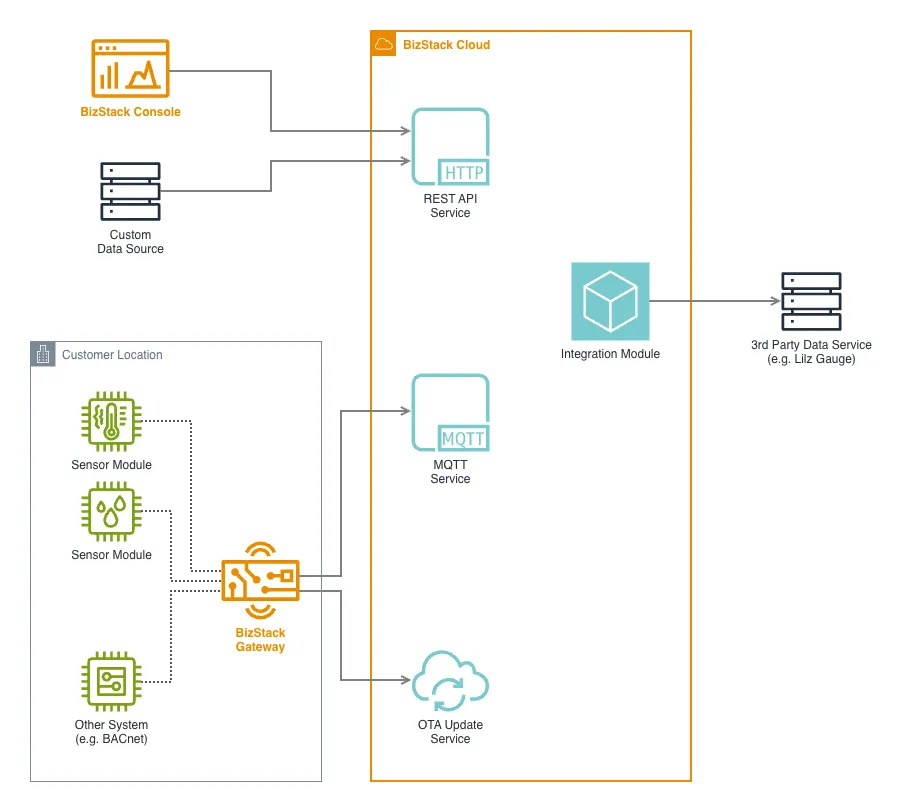
BizStack Cloud
- Multi-tenant, hosted cloud service
- Sometimes referred to as the “MODE Cloud”
- Most clients use the REST API
- BizStack Gateways (and other IoT devices) use the MQTT interface
- Handles data routing, organization, storage, and retrieval
- Data types include:
- Time series data
- Structured log data
- Geolocation data
- Video feeds
- End user IAM
- Data acquisition from other 3rd party data services via Integration Modules
BizStack Gateway
- A hardware device that connects to on-site sensors and systems via a broad range of protocols.
- Communicates to BizStack Cloud mainly via MQTT and HTTP.
- Internet connection via Ethernet, Wi-Fi, or SIM dongle.
- Supports remote configuration and over-the-air firmware updates.
- Custom modules can be implemented to collect data from proprietary systems on site.
BizStack Console
- Web frontend application for end users to navigate and visualize data, and to perform administrative tasks.
- User-configurable dashboards (supports custom widgets via “plugins”)
- Data sources management and data routing configuration
- Gateway fleet management
- User management
- Alerts configuration
Key Concepts of BizStack
The following concepts are crucial to understanding BizStack’s operations:
- Project
- Data Source
- Device
- Entity
- Data Routing
- Home
Project
- Project is the largest unit in BizStack.
- Project is provisioned by MODE per contract.
- Each project has its database of user accounts.
- Data never crosses projects (strong isolation)
Data Source
Represents an origin of data to be injected into a Project. There are two main categories of data sources:
- Data collected via BizStack Gateway, from
- Supported senors (environment, occupancy, leak detection, etc.)
- Building or industrial automation systems
- Data collected via cloud-to-cloud integration
- Officially supported 3rd party data services (Lilz Gauge, Mimawari Denshobato, etc.)
- Custom data injection programs
Device
- Any hardware device that collects data from data sources and relays the data to a project.
- Also expected to support a set of protocols for:
- Remote device configuration
- Real-time bidirectional communication
- Over-the-air firmware updates
- BizStack Gateway is one example of such a device
Entity
- Represents abstract or concrete “things” (companies, business units, regions, buildings, factories, equipment, etc.)
- Also serves as a kind of container of measurement data, files, video streams, meta data, etc.
- Can be organized into a tree structure for intuitive navigation and access control.
Data Routing
- A Data Route specifies how data from a data source should be stored in a project.
- It specifies which target entity and which data store within the entity should be used.
- Optional data “filtering” and “transformation” can be specified.
Home
- Unit for grouping devices, data sources, entities, and data routes.
- Allows a project to be split into isolated partitions.
Customization and Integration
The BizStack platform offers multiple ways for custom development:
- Custom data injection via REST API
- Custom REST API endpoint extensions that proxy requests to external servers (App Proxy)
- Custom UI plugins in BizStack Console
- Custom webhooks to external servers
- Custom data acquisition module inside BizStack Gateway